Generative AI with LangChain (Second Edition) Review: The Ultimate Guide to Building Production-Ready AI Applications
Authored By : tdnshah
Published On
Wednesday, Jun 3, 2026
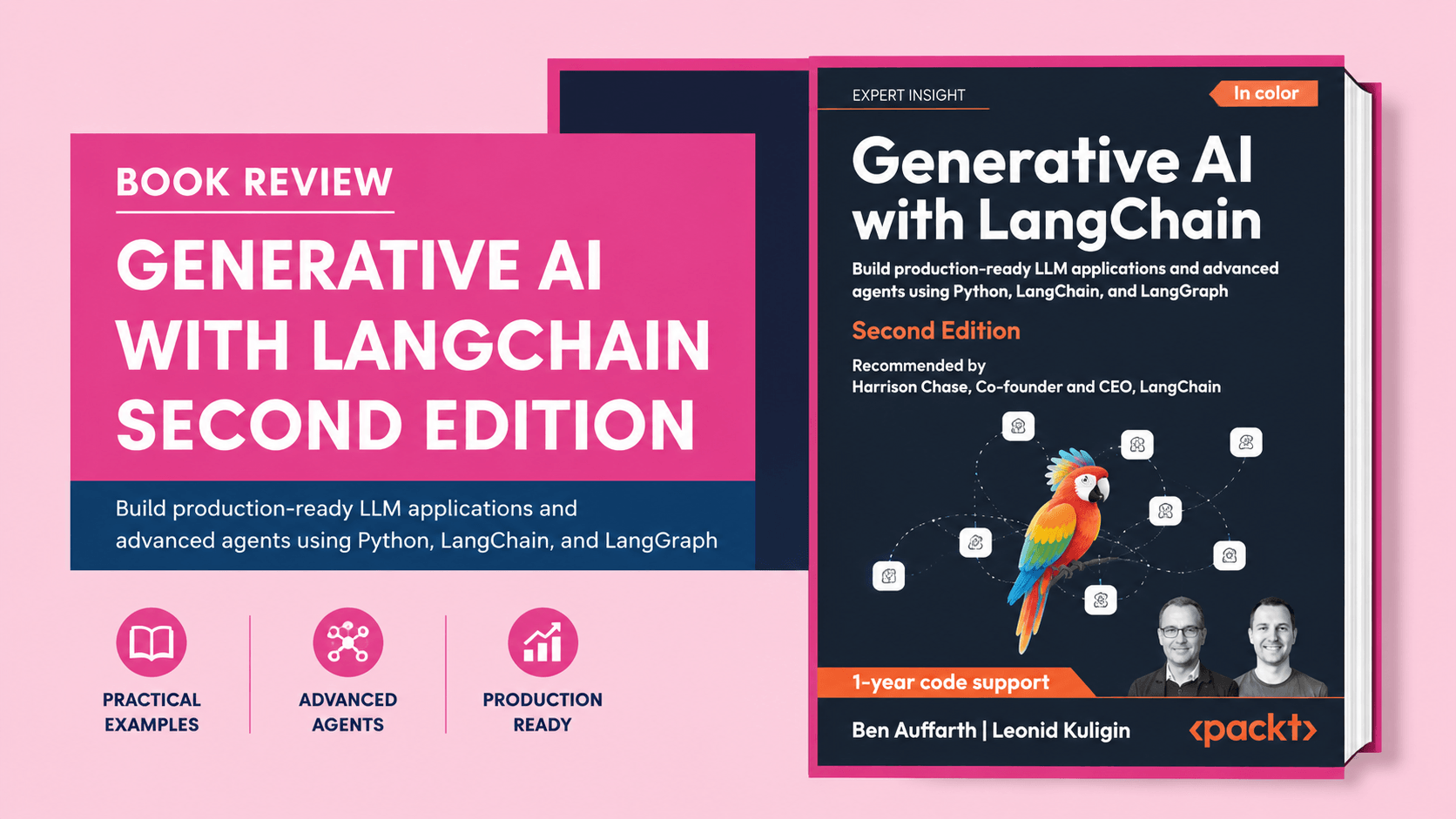
Generative AI with LangChain (Second Edition) Review: The Ultimate Guide to Building Production-Ready AI Applications
Artificial Intelligence is no longer just about building chatbots. Today’s AI engineers are expected to design scalable, production-ready systems capable of reasoning, retrieval, orchestration, and autonomous decision-making. That’s exactly where Generative AI with LangChain – Second Edition shines.
Written by Ben Auffarth and Leonid Kuligin, this book serves as a practical guide for developers who want to move beyond simple LLM demos and start building enterprise-grade AI applications using Python, LangChain, and LangGraph. The second edition was released in May 2025 and extensively updated to cover modern agent architectures, advanced RAG implementations, and production deployment patterns.
Why This Book Matters
One of the biggest challenges in Generative AI today is bridging the gap between proof-of-concept projects and production systems. This book directly addresses that challenge by focusing on real-world implementation patterns rather than theoretical concepts alone.
The authors cover:
- LangChain fundamentals and architecture
- LangGraph workflows
- Multi-agent systems
- Retrieval-Augmented Generation (RAG)
- Structured reasoning techniques
- Agent handoffs and orchestration
- Evaluation and monitoring
- Production deployment best practices
What makes this book particularly valuable is its emphasis on building reliable AI systems that can scale in enterprise environments.
Highlights from the Book
1. Practical LangChain Development
The book starts by introducing the modern LLM ecosystem and demonstrates how LangChain simplifies the development of complex AI applications. Instead of relying solely on raw API calls, readers learn how to build maintainable and modular AI workflows.
2. Deep Dive into RAG Architectures
If you’re building AI systems that need access to external knowledge, the RAG chapters are incredibly useful.
You’ll learn:
- Document ingestion pipelines
- Embedding strategies
- Vector databases
- Hybrid search
- Re-ranking techniques
- Fact-checking workflows
These concepts are essential for reducing hallucinations and improving answer accuracy in production systems.
3. LangGraph and Agentic AI
The standout feature of this edition is its extensive coverage of LangGraph.
The book explores:
- State-based workflows
- Multi-agent architectures
- Agent communication patterns
- Workflow branching
- Human-in-the-loop systems
As the AI industry increasingly moves toward agentic workflows, this section alone makes the book worth the investment.
4. Production Readiness
Many tutorials stop once a chatbot works.
This book goes much further by discussing:
- Observability
- Monitoring
- Evaluation frameworks
- Error handling
- Security considerations
- Responsible AI development
These topics are often overlooked but are critical for deploying AI systems in real business environments.
Who Should Read This Book?
I would strongly recommend this book for:
- AI Engineers
- Python Developers
- Machine Learning Engineers
- Data Scientists
- Software Architects
- Technical Leads
- Developer Advocates
- Startup Founders building AI products
Whether you’re developing internal copilots, customer support agents, AI automation platforms, or advanced RAG systems, you’ll find practical value throughout the book.
What I Liked Most
The biggest strength of this book is its focus on implementation.
Rather than simply explaining what LangChain is, the authors show how to combine LangChain and LangGraph into complete systems that solve real business problems.
I also appreciated the inclusion of advanced topics such as:
- Multi-agent collaboration
- Tree-of-Thought reasoning
- Structured generation
- Agent handoffs
- Evaluation and testing strategies
These are the areas where many AI projects struggle, and the book provides practical guidance for addressing them.
Overall Rating
⭐⭐⭐⭐⭐ 5/5
If you’re serious about building production-ready Generative AI applications, this is one of the most valuable resources currently available.
It successfully bridges the gap between experimentation and deployment while providing hands-on examples that developers can immediately apply to their own projects.
Get Your Copy
Ready to level up your AI engineering skills?
👉 Purchase the book here: https://amzn.to/4o2MKKy
Whether you’re exploring LangChain for the first time or building sophisticated AI agents with LangGraph, this book provides a strong roadmap for creating modern, production-grade AI systems.
Affiliate Disclosure
This post contains an affiliate link. If you purchase the book through the above link, I may earn a small commission at no additional cost to you. I only recommend books and resources that I genuinely believe provide value to developers and AI practitioners.
Please give us your feedback on our articles and if you find them helpful, click the thumbs up icon to motivate us to write more.